Showing posts with label Apologetics. Show all posts
The following post outlines some key points and maxims concerning the attribute of self-sufficiency that Yahweh, God, possesses as determined from Biblical scriptures.  
I hope you find these statements to be interesting and thought provoking and that they will impact your life and how you view God; that it would lead you into a more reverent and worshipful mindset based on His holiness and glory.


• If anything was necessary to God, that thing would be a measure of His imperfection.    
  Imperfection is something that is entirely impossible of God's character.

• "Whatever God is, and all that God is, He is in Himself."
   All life is a gift from God.  He cannot receive anything that He has not first given.

• God is solely unique in that he is the only thing that is complete - the only thing that does not
   require something outside of itself in order to exist.

Excerpt from A.W. Tozer's Knowledge of the Holy 
                (Chapter 5: "The Self-Existence of God"):


         "The human mind, being created, has an understandable uneasiness about the Uncreated.  We do not find it comfortable to allow for the presence of One who is wholly outside of the circle of our familiar knowledge. We tend to be disquieted by the thought of One who does not account to us for His being, who is responsible to no one, who is self-existent, self-dependent and self-sufficient."


Creative Commons Photo Credit
"One of my friends has a question but wants to stay anonymous:
Why didn't He write the Bible in plain English instead of a bunch of stories and riddles that allow room for misinterpretation?"

Hey, thanks for the question! This is definitely a tough one, and Christians have been asking this question for millenia.
Questions.
Creative Commons Photo Credit
My brother, AJ, was a part of the Campus Crusade ministry at UW-La Crosse last semester, and as a part of that ministry they started a Facebook group called "God. Why?" which was designed to let people ask difficult questions that they have been wondering, and then hopefully help other people provide answers to them.

In this new series entitled "Tough Questions,"  I'm going to take a crack at answering a number of these questions.

I'm not tackling this project because I think I know it all or even because I think I am the most qualified person to answer these questions. Rather, I just think that these questions need good answers, and that someone needs to make an attempt to provide them.

I may not be able to provide exhaustive responses that cover every single angle, but I will do my best to provide a Biblical perspective on the topic!

Your Turn: Do you have a tough question about Christianity that you want answered? Feel free to leave it in the comments section below, or email me at g.gaheil AT gmail DOT com.

I am constantly amazed by the vastness and complexity of the universe.  

As a university student, each day I have the pleasure of learning about different aspects of the world that we live in - societies, culture, communication, environments, organisms, and so many other facets of life. 

For instance, I was simply fascinated to learn the following information through my first lecture in a basic biology class.  By no means is this an advanced or difficult course (the reason that I am taking it is to fulfill a prerequisite for a future class),  but nevertheless, one can learn a great deal from the material presented!

http://newton007.com/unseen/wp-content/plugins/WPRobot/images/14d65_biodiversity.jpg
I found out that my philosophy proffessor, George Wrisley, Ph.D., has a philosophy blog. Being a blogger myself, I was pretty excited! He's written some very interesting essays, so I encourage you to check his site out.

I decided to respond in length to one of the posts that I've read so far (entitled "A Difficult Dilemma: Deny that Humanity is Fallen, or Deny Evolution?"), and I thought I'd republish my comment here for you all to read:


Darwin the Messiah

Greg Heil | 9:36 AM | 7 Comments
I find these little fish bumper stickers a very fitting representation of the essence of Darwinism.

What's the difference between the first sticker and the second? The second has legs, yes, but the primary difference is the spot that Jesus occupied is now replaced by Darwin. 

Originally written in 2008.

I believe that there is incredible proof beyond a reasonable doubt for the fact that Jesus Christ claimed He is God, that He truly is God, and that He rose from the dead. Like the reliability of the New Testament documents, the entirety of the Christian faith relies on this point. But don’t take my word for it, read on and look at the evidence.

Many people promote the concept of world peace - A world without war, calamity, pain, violence, and suffering - A world without evil. We dream of a society in which there are no hardships and no stress to be had. If only we could live without worries, without emotional pain and toil.  Wouldn't that be a perfect world?
Would it?
Although this ideal may be appealing in many ways, I submit to you that it should not be a world that we desire to live in.  A world without evil, could quite possibly be the worst world of all.


Here is my reasoning...

For this article, we will be dealing strictly with the idea of the Christian God (i.e. the God of the Bible, Yahweh) and no other conceptual deities.

Time and time again, one of the most noteworthy arguments against the existence of God is presented by suggesting this question: If evil exists, how can an omnipotent, loving God exist?

Photo Credit
One might say, "God does not exist. I know this because evil and human suffering exist all around me; because innocent children are dying; because God would eliminate evil from the world if he was really a loving God; because my father suffered painfully for two years before dying in a hospital in Indiana; because tsunamis and earthquakes rip the lives away from thousands of people each year. Why would God allow that to happen?"

Let's examine the concept in more detail. Is the existence of evil directly paradoxical to the God of the Bible?


Photo Credit
Originally written in 2008.

The authenticity of Christianity is greatly affected by the reliability of the New Testament documents. If they are reliable, the Christian faith is really bolstered. If they are not dependable, then Christianity does not count for a whole lot.


Photo Credit
The following is an essay that I wrote during an Apologetics class at Big Sky Bible Institute back in the fall of 2007. This is a short paper and is very broad in scope. There is much more specific evidence that I didn't have time to address. Hopefully I will have that opportunity some time in the future.

The title that I chose for this paper was not phrased the way it is by accident. I am going to attempt to present evidence for the existence of the Christian God. I am not going to prove with one hundred percent certainty that the Christian God exists. I do, however, believe that the vast majority of evidence truly does point towards the existence of God.


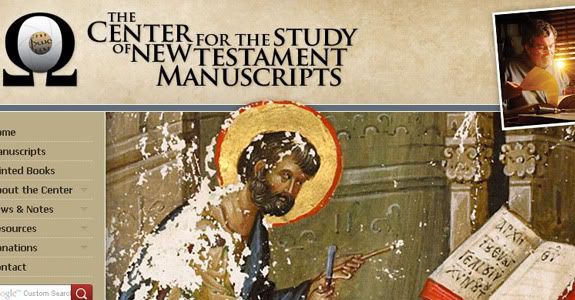
CSNTM.org
CSNTM.org is "The Center for the Study of New Testament Manuscripts." One of their main goals is to create a database including a digital photograph of ever single New Testament manuscript in existence. It's an incredible endeavor! Be sure to click over and check out images of the actual documents that our present day Bibles are made from! (I used a portion of one of these images for the picture in Part 3 of the recent series.)

Part 3: The New Testament: Transmission and Textual Criticism

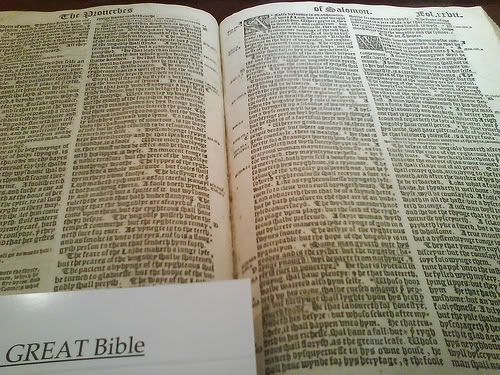
The Great Bible
Photo Credit
Wycliffe and Tyndale
Due to the language that this paper is being written in, the development of the English translations are the ones that will be covered in detail. The first English translation was made by Wycliffe in 1380, and updated in 1388. Wycliffe faced a great deal of persecution during the making of his translation. The church wanted to keep power in the hands of the priests and keep the common people in the dark.

Part 2: The Old Testament: Transmission and Canon

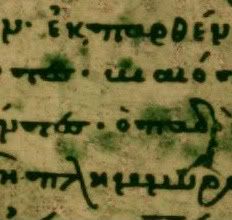
New Testament Manuscript
Photo Credit: CSNTM.org
Manuscript Location:
University of Michigan, Ann Arbor
Transmission
The books that make up the Old and New Testament canon were transmitted down to today’s Christians in quite different fashions. The Old Testament was mainly transmitted via professional scribes who copied it. Many of the people of the time were not capable of reading and writing, so there were people specifically trained to copy the scriptures. These people were called scribes. This was their occupation, and as such they did a high quality, professional job. There were very stringent guidelines in place dictating how exactly the scribes were to go about copying the scriptures. For instance, they had to count all of the letters on a completed page, to verify that they had done an acceptable job. If they had more than three errors per page, they were required to start over. This ensured a very, very accurate transmission of the Old Testament down to current times.

Read Part 1: "Errors" and Inerrancy

Cumran Cave 4: Where the
Dead Sea Scrolls were discovered.
Photo Credit.
How, then, did the Old Testament come down to us living in the 21st century? The Old Testament originally came from the Jews. It was, and still is, their holy book, their revelation from God, which is written down in the TaNaK in Hebrew, and was translated into Greek in the Septuagint. The Jewish oral tradition also passed down the view of our modern 39 books of the Old Testament, in a slightly merged form of 24. Josephus records that the Jews kept to a list of 22 holy books, which, in actual fact, equals the 39 books currently held in the protestant Old Testament. So, Christians carry the same general view of the Old Testament, but they also add the New Testament to it to make up what is called the Bible.

Photo Credit.
When trying to determine if the Bible can be trusted, the first thing we must do is examine the scriptures and decide for ourselves if they contain any errors. But first, what is the definition of an error?

What Is an Error?
An error is essentially something that is stated incorrectly, or a statement that exists which is in direct contradiction to a known fact. However, apparent errors in grammar or spelling do nothing to erode scriptures reliability, for grammar and spelling are simply human conventions, things that humans have come up with, and which are subject to change over the course of time. 

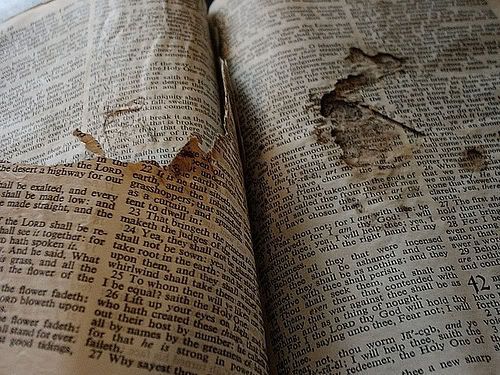
The Bible
Photo Credit.
The issue of whether or not the Bible is trustworthy is in its very essence a critical topic. If the Bible is not worthy of having trust put in it, as a Christian, your eternal salvation, and indeed, your foundation and basis for all motivation in life collapses in a pile of rubbish.

You must be pretty sure that the thing in which your faith is put in has a backbone to it, and will be able to stand an objective examination of reliability. If the Bible proves not to have such a backbone, those who count themselves Christians will have to drastically rethink their entire view of life’s meaning and goals.

Note: This was written back in 2008 as a reflection on a section of a book I had been reading for a class. I'm not 100% sure which book it is, but I believe it was Prayer: The Great Adventure. I was attending Big Sky Bible Institute in the mountains of Northwest Montana, and was doing a ton of powder skiing at Big Mountain.

What David Jeremiah said about the mountains “clearing your head,” “something wonderful happens to you when you go to the mountains,” and “God created the mountains and the ocean as therapy for His people” is so true. Just last week I was struggling with some serious considerations in my head, that really aren’t all that uncommon. But last week was more intense than usual, more depressing and despairing.

I found myself thinking, “I had such a conviction in the existence of God at one point, where has it gone to? God, if you are really out there, please show me once again the conviction that I had of your existence and your power.”